Data Sovereignty
Deployment options support local data residency requirements through on-premises or private cloud environments, helping institutions comply with national and regional data governance requirements.

All patient data is secured using AES-256 encryption at rest and TLS encryption for all data in transit.
Patient IDs are automatically hashed using SHA-256 before storage to prevent identifier correlation and protect privacy.
Role-Based Access Control (RBAC) allows administrators to define exactly which patients and units each staff member can view, with configurable permissions across both the dashboard and mobile app.
Protected by API key authentication, configurable access controls, and comprehensive input sanitization to guard against injection attacks and unauthorized access.

Deployment options support local data residency requirements through on-premises or private cloud environments, helping institutions comply with national and regional data governance requirements.
Only the clinical data needed for each assessment is processed. Nothing more is collected, stored, or retained.
Dedicated API endpoints enable on-demand deletion of patient data, supporting applicable privacy regulations, including right-to-erasure requirements.
Configurable TTL policies automatically purge outdated patient state data, reducing retention risk without manual intervention.
Hospitals define system-wide retention policies that automatically delete patient state after a configurable period, ensuring compliance with internal governance requirements.
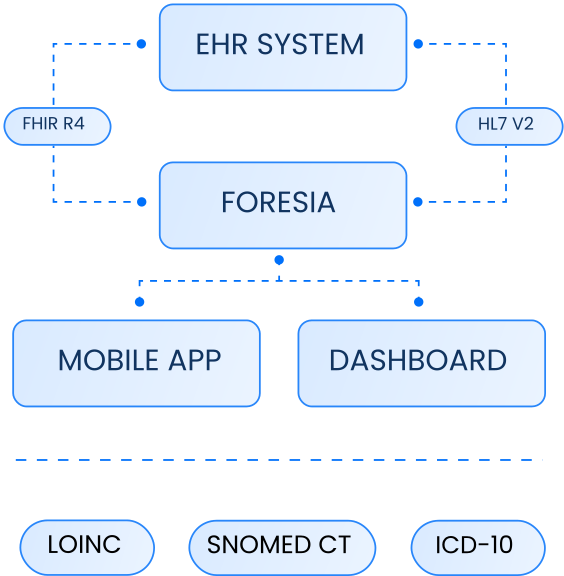
Built on HL7 and FHIR standards for interoperability with leading EHR platforms. Integration requires LOINC code mapping configuration, which is supported through the Foresia Admin Dashboard.
Supported clinical coding standards ensure data accuracy across systems:
Foresia's architecture is structured to align with ISO 9001 and ISO 27001 requirements, supporting HIPAA, PIPEDA principles, and GDPR-informed privacy practices.
Configurable deployment models support regional data governance requirements, helping institution meet applicable national data residency and privacy obligations.
All system interactions are logged, providing the evidence trail required for hospital accreditation audits.
Advancing Healthcare With Trusted Partners